


STELLAR PST TO OFFICE 365 MIGRATION TOOL
The native methods provided by Microsoft—Network Upload and Drive Shipping—require to perform multiple steps, use of PowerShell commands, and have PST size limitations. These methods are not suitable when PST files are large or scattered across multiple systems. With Stellar Migrator for Outlook, you can directly import PST files into Office 365 with no dependency on Outlook. It also offers an option to choose the target primary mailbox, archive mailbox, or public folder before starting the migration. The tool even supports large PST files with option of auto-splitting for stable migration.
In real-world scenarios, PST files are usually scattered across systems, shared folders, or network paths, thus making it difficult and time-consuming to manually collect and store the files at one place before migration. With Stellar Migrator for Outlook, you can upload PST to Office 365 directly from any system or network location without the need to move the files to a single location or install the tool on each source system. The tool allows the users (with admin credentials) to log in from multiple systems, manage their licenses, and run the migration jobs independently. It is an ideal tool for distributed teams, MSPs, and large enterprise environments.
Migration of encrypted or password-protected PST/OST files using the manual methods is not feasible or require installation of Outlook. Stellar Migrator for Outlook supports migration of large, encrypted, or password-protected Outlook data files without the need to install Outlook. The tool ensures a stable, error-free PST to Office 365 migration with complete data integrity and zero dependency on the source machine setup. It uses Modern Authentication method to connect to the destination server for secure migration of data.
Key Features of Stellar Migrator for Outlook
This PST to Office 365 migration tool allows you to directly import PST into Office 365 without Outlook dependency or following the lengthy Network Upload process or using the complex PowerShell commands. You can simply connect to the Microsoft 365 tenant using either Auto Registration or Manual Registration. The Auto Registration option allows you to automatically connect to Microsoft 365 by using Microsoft Azure (Entra ID) credentials, making the setup fast and effortless. Choosing Manual Registration option requires you to manually enter the details, such as Email Address, Application (Client) ID, Directory (Tenant) ID, and Client Secret Value to establish a secure connection. Once connected, the tool automatically fetches all the Microsoft 365 mailboxes and performs email-based auto-mapping. You can also manually change the mailbox mapping. This ensures smooth, accurate, and direct PST to Microsoft 365 migration with folder hierarchy and structure intact.
This PST migration tool can directly migrate Outlook data files in bulk to a live Exchange Server without going through the complex process of creating and running PowerShell scripts. To migrate to live Exchange Server, you have to first connect to the target (Exchange Server) by using Autodiscover Email or manually entering the details. When you choose the Use Autodiscover Email option, the tool automatically locates the correct settings using your email and password. If you select the Manually Enter Details option, you are required to log in with credentials, such as Exchange IP address/FQDN, Email address, and Password. The tool automatically maps the mailboxes to the destination server mailboxes, significantly reducing the time required for mapping the mailboxes manually.
Stellar Migrator for Outlook provides an option to migrate Offline mailboxes data to new PST files. This comes in handy when you have to create a backup or archive of mailboxes data. The tool preserves the folder hierarchy and structure, and maintains data integrity during the migration process. It also allows to set date filters and customized the settings to help users granularly export the data to PST.
When using manual migrating methods, you are required to manually map the mailboxes from the source to the mailboxes on the target server. This manual process can take a lot of time when you are dealing with a large number of mailboxes. This PST to Office 365 migration tool auto-maps the mailboxes from the source (Outlook data files) to the target server (Microsoft 365 or Exchange Server) to simplify the mapping of the mailboxes. The tool also allows to manually map the mailboxes or change the mapping.
OTHER FEATURES OF PST TO OFFICE 365 MIGRATION TOOL
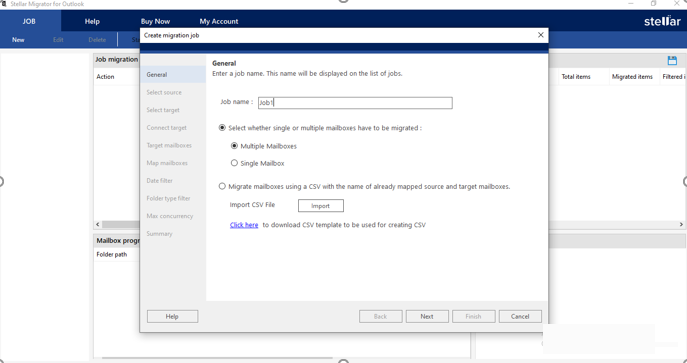
This PST to Office 365 tool simplifies the process of migrating mailboxes in bulk to Microsoft 365 and live Exchange Server by using CSV file with the names of already mapped source and target mailboxes. For this, you just need to import the already mapped source and target mailbox CSV file using the Import button located under Migrate mailboxes using CSV.
This PST migration tool supports migration of encrypted Outlook data files without any hassle. The user just need to enter the password and the tool then effortlessly migrates all the mailbox items, including emails, contacts, calendars, attachments, and others from the encrypted data file to Microsoft 365, live Exchange Server, and PST archive.
Stellar Migrator for Outlook comes with an Auto-Split feature that automatically splits the large resultant PST files. When migrating the Offline mailboxes data to new PST files, this PST to Office 365 migration tool automatically splits the output file at approximately 45 GB. This feature helps prevent corruption in PST file due to large size and makes it easy to access or import the files into Outlook or other platforms.
In case the migration process is stopped due to any reason, re-running the migration process can cause duplication of data. This increases the migration time and disk space. Stellar Migrator for Outlook supports delta (incremental) migration. It ensures that only new or modified data is migrated when re-running the process, thus helps reduce time and resource consumption.
Stellar Migrator for Outlook allows you to import the PST file data into a specific folder in a Microsoft 365 or Exchange Server mailbox, giving you full control over the migration. Instead of importing everything into the primary mailbox, you can choose a Specific Folder on the destination server and import the entire mailbox hierarchy exactly as it exists in the source file. This feature facilitates structured, clutter-free migration and helps in keeping historical, department-wise, or multi-year PST data organized. It is especially useful for onboarding users from previous organizations, consolidating multiple PSTs, or meeting compliance requirements.
This PST to Office 365 migration tool provides advanced filtering options that provide users control over the migration process. At the time of migration, users can apply Date filter to migrate all the items or include items older than a particular date, items not older than a particular date, or items based on a specific date range. It also provides a Folder Type filter to exclude or include mailbox data based on folders type, such as Emails, Contacts, Tasks, Calendars, Journals, and Notes. It also offer options to include or exclude special folders, like Drafts, Deleted Items, and Junk Email. These features allow users to selective import of data, thus helps reduce migration time.
This PST migration tool provides a Job Summary to review and verify the migration job before initiating the migration process. When you reach the final stage of setting up the migration job, the tool displays a consolidated overview of all critical settings—including job name, source and target types, total number of mailboxes, auto split status, applied date and folder type filters, and concurrent mailboxes, which allow you to verify that everything is correct before initiating migration.
This PST to Office 365 tool provides real-time monitoring of migration process - during and after completion. This ensures smooth management of the entire migration process. Once the migration job is underway, users can monitor the progress in real-time and generate two key reports: Job Progress and Mailbox Progress. The Job Progress report displays high-level metrics, such as total vs migrated items, filtered or failed items, and overall status. The Mailbox Progress report provides folder-level insights, including migration percentages, item counts, and success/failure details per folder. These reports can be easily exported to a user-defined location.
This migration tool allows to migrate up to 10 mailboxes at a time to speed up the migration process. It also provides an option to set the number of mailboxes to migrate simultaneously. This allows the users to balance the migration speed depending on the available system resources.
DATA SHEET
| Version: | 2.0.0.0 |
| License: | Pay-per-use |
| Edition: | Technician |
| Language Supported: | English |
| Release Date: | November, 2025 |
| Processor: | Intel compatible (x64-based processor) |
| Memory: | 16 GB (recommended) 8 GB (minimum) |
| Hard Disk: | 250 MB of free space |
| Operating System: (64 Bit only) |
Windows 11, 10, 8.1, 8 & Windows Server 2022, 2019, 2016, 2012 |
| Exchange Server Support: | Exchange Server all versions, 2019, 2016, 2013, 2010 |
FIND YOUR ANSWERS
You can directly import PST files into Office 365 (Microsoft 365) by using Stellar Migrator for Outlook. You just need to select the PST files (source) you want to migrate and then connect to the Microsoft 365 using the Auto Registration or Manual Registration option in the tool. The tool then auto-matches source mailboxes with the mailboxes on Microsoft 365. It also provides option to manually map the mailboxes. After mapping, you can just start the migration process.
Yes. This migration software supports migration of both OST and PST files to Microsoft 365 or Live Exchange. You have to first select the source (OST or PST files) and then connect to the target server (Exchange or Microsoft 365). To connect to Microsoft 365, use the Auto Registration or Manual Registration option. To connect to Exchange Server, enter the Autodiscover Email or manually enter the details. The tool then auto-map the source mailboxes with the mailboxes on the target server. You can also manually map the mailboxes or change the mapping. After that, start the migration process.
Yes. This tool allows administrators to import multiple PST files into different Office 365 mailboxes in one operation — ideal for enterprises or MSPs. To migrate multiple mailboxes, it also offers an option to use a CSV file with the list of already mapped source and target mailboxes.
You need admin credentials with Application Impersonation rights on the destination server - Microsoft 365 or Exchange Server. The setup wizard of the tool provides clear steps to configure these permissions easily.
Yes. You can migrate PST file items based on specific dates by using this software. You can use the Date filter option to migrate all the items or include items older than a particular date, items not older than a particular date, or items based on a specific date range. You can also include or exclude specific folders, such as Emails, Contacts, Tasks, Calendars, Journals, Notes, Drafts, Deleted Items, and Junk Email.
Yes. You can upload a CSV file containing pre-mapped source and destination mailboxes. This makes the bulk mailbox mapping fast and error-free. However, the CSV file should be in a proper format for correct mapping at the time of migration.
This PST to Office 365 migrator software uses adaptive throttling management and parallel connections to maintain steady performance, even when the Microsoft 365 imposes rate limits.
Yes. With this PST to Office 365 migration tool, you can pause, resume, or re-run a migration job, without data duplication. The tool automatically retries the migration of failed items and continues from the last completed point.
Yes. This tool supports incremental (delta) migration. This feature allows you to migrate only new or updated items after full migration, thereby, eliminating duplicity of data during migration and saving time and bandwidth.
This migration tool uses OAuth 2.0 and Modern Authentication (ADAL) protocols to securely connect with Office 365 and Exchange Server. Your data is migrated directly to the target server with full encryption and zero local caching.
Yes. Stellar Migrator for Outlook supports migration of password-protected and encrypted Outlook data files (OST and PST) to the target environment, without compromising data integrity.
Yes. This tool preserves folder hierarchy and mailbox structure, after the migration. This ensures that the migrated items appear in the same organized format in the target mailbox as they appeared in source (OST/PST files).
This Microsoft 365 migration tool provides real-time monitoring of the process - during and after completion of migration. You can view/monitor the migration progress in real-time and generate two key reports: Job Progress and Mailbox Progress. The Job Progress report shows information such as total vs migrated items, filtered or failed items, and overall status. The Mailbox Progress report displays folder-level insights, such as migration percentage, item counts, and success/failure details per folder. You can also easily export these reports.
The software logs the failed items separately and allows targeted re-runs. In case the migration job fails, you can migrate only incomplete mailboxes, instead of restarting the migration job.
Stellar provides 24×5 technical support via chat, email, and phone. Our tech experts assist the users in resolving issues related to setup, permission configuration, and also help in live troubleshooting to ensure successful completion of the Office 365 PST migration.
WHY STELLAR® IS GLOBAL LEADER
0M+
Customers
0+
Years of Excellence
0+
R&D Engineers
0+
Countries
0+
Partners
0+
Awards Received